Archival Transfers and Film Restoration Services
Film Preservation: Some basic information to get you started down the right path
Moving image preservation and restoration services for archival 16mm and 35mm movie film has become of increased importance to many in the field of education, academics, library sciences and documentary research. Motion picture film collections preserved on the volatile 35mm nitrate stock that are in danger of further deterioration are prime candidates for transfer to 10-bit uncompressed digital files while the image can still be safely recovered. Even very old and somewhat fragile 16mm movie film that has begun to dry out, shrink or crack should be given serious consideration before recovery becomes near impossible altogether or a substantial financial hardship for the library, university or the individual who owns the material.
At the very least those charged with the safe keeping of these motion picture film elements should do a top to bottom inspection of the condition of the materials and examine just how they are being stored. The use of plastic or aluminum reels in place of the old steel type, which will almost certainly rust over time and leach corrosion into the film, is an absolute must. The temperature and humidity of the "film vault" where archived material is stored, if there even is one, should be closely monitored. A good starting point for achieving proper storage is to abide by the "40-40 Rule". That means 40 degrees F and 40 percent humidity for the vault or room that will be used to house the film.
It is a sad fact that whole collections are being disposed of daily either due to a lack of knowledge or a lack of funding or possibly both. Our company, TFG Film & Tape, offers a film restoration service for those films that have reached the critical stage of deterioration but may still be salvageable using the proprietary Film-O-Sizing process we have developed.
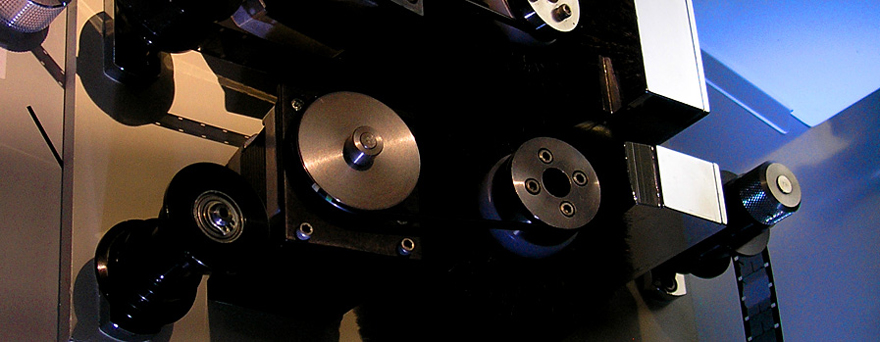
Our Film Restoration History
Since 1981, TFG has maintained an archival film to video transfer operation specifically designed to painstakingly and meticulously convert rare, priceless old 35mm,16mm and 8mm film material to today's most popular video tape and digital formats. Our expertise has been called upon to transfer rare or historically significant film footage for the Wadsworth Atheneum, The Mark Twain House Foundation, Otis Elevator, The Hartford Insurance, Travelers Insurance, The Connecticut Historical Society, Pratt & Whitney Aircraft, The Rhode Island Historical Society, Mystic Seaport, Electric Boat, Connecticut Public Television, ESPN and countless others. We will gladly examine any film needing restoration at no cost to the owner and provide an opinion as to what can and should be done to preserve the images it contains for the future.
Film-O-Sizing Treatment for Correcting Damaged Movie Film
In some instances, a film reel or portion of a reel may be in very poor physical condition due to its age or past storage conditions. It may be degraded to the point of being warped, buckled, shrunken, twisted or curled well beyond the point it can still be projected much less converted to another medium. We are able to perform many levels of film restoration and correction for you using our proprietary Film-O-Sizing process.
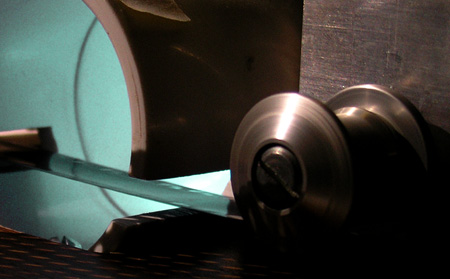
Film-O-Sizing is a gradual,
condition-specific, multi-step process that can clean, condition, correct and restore damaged film.©
The process can be applied to both color and B&W 16mm safety films and to both originals and prints needing restoration. Films that were once thought unsalvageable due to the level of decay either physical or by mold or mildew can, in a great many cases, now be recovered at least long enough to be converted to a digital format.
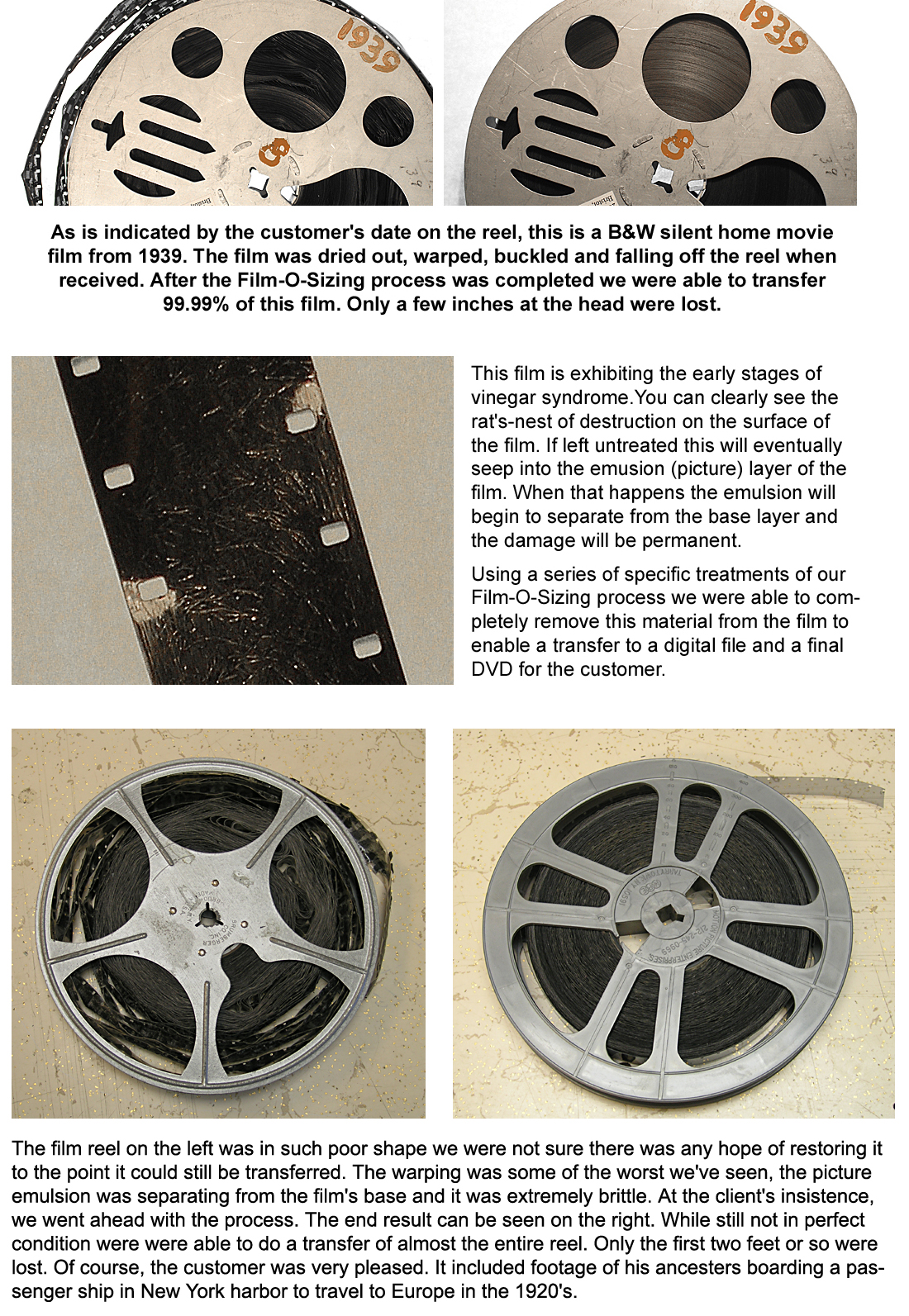
Below, are some common examples of film damage before and after being treated with our Film-O-Sizing restoration process.
Charges for archival film transfer work can vary depending on the amount and condition of the movie film and the time, equipment and procedures required to perform the restoration, correction, cleaning, and conversion. It is very important the client not attempt to unwind a roll of potentially fragile motion picture film that is suspect as this can crack the emulsion or brake the film beyond repair. Film that exhibits a strong vinegar smell or odor may indicate the base layer that supports the emulsion (picture layer) has begun to deteriorate or decay. A white powdery residue on the outer edges of the film may also be present as further indication the film is in peril. If you suspect your film to have condition issues it is best to seek professional help, first.
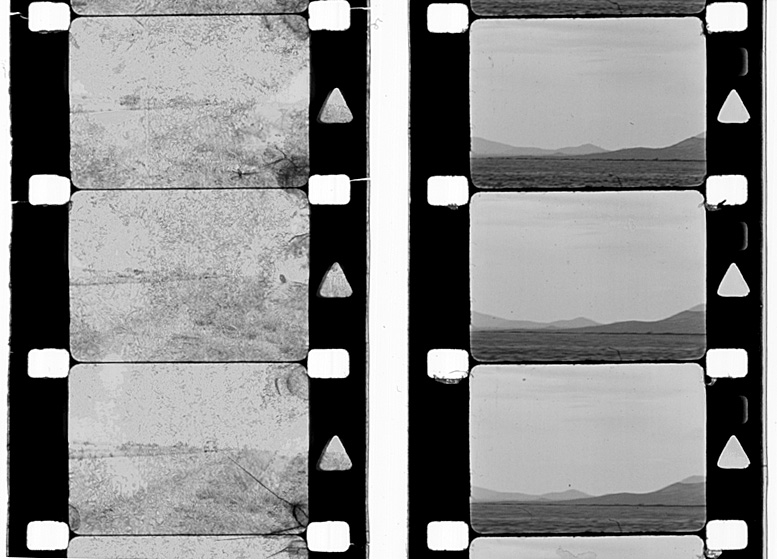
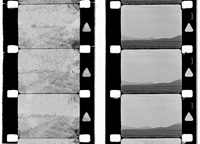 The picture on the left shows a section of original 16mm B&W film from the 1940's before and after Film-O-Sizing restoration treatment. When received in our lab the film was extremely dirty. A fungus was covering the film causing the image to be almost unviewable. Through an extensive but gentle cleaning the mold that had attached itself to the film has been safely and completely removed while leaving the image unharmed and intact. A successful transfer to a digital file and a very satisfied client was the end result. If left uncorrected this film would have deteriorated to the point where saving it would have been near impossible.
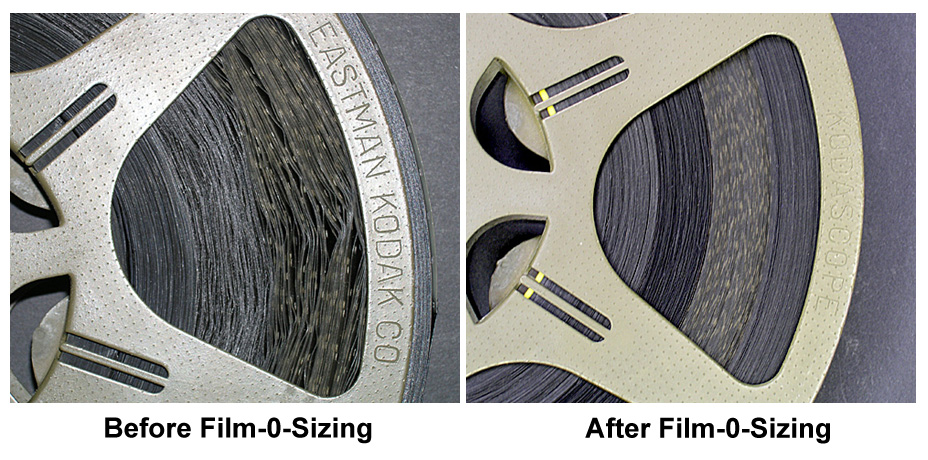
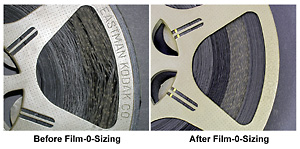 The picture on the right shows a typical reel of severely damaged 16mm film from the 1940's. You can clearly see the buckling and warping in the first picture in this side view of the reel. In fact the buckling is so bad the film is literally coming off the the reel. The second image shows how the film appears after our Film-O-Sizing film restoration process has been applied. The warping has been corrected and an irreplaceable camera original film that was once thought destined for the trash now sits neatly and tightly on the reel ready for transfer.



Our Film Transfer Facilities
We maintain telecine transfer systems utilizing large-area imaging tubes as well as digital CCD line arrays, computerized scene by scene density and color correction, vacuum and/or particle transfer roller dust collection, electronic grain and random pattern video noise reduction. Many times the only available existing source of specific material needed for a documentary are old and worn out 35mm or 16mm film prints. Our scratch and dirt concealment techniques include chemical, optical and software technologies that, when combined together as a three-pronged approach, go a long way towards solving this difficult problem prior, during and after the digital transfer.
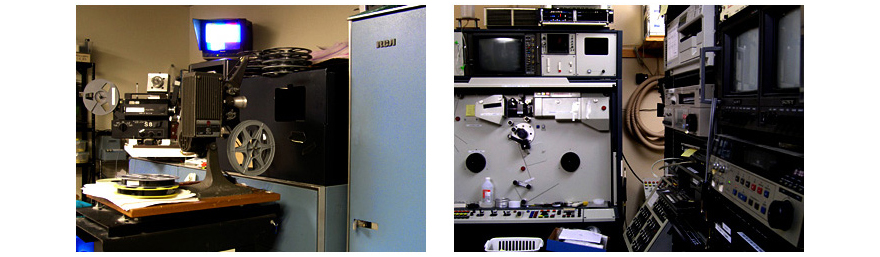
All work is done at our Connecticut USA facility. Your films never leave our site or our care!
We do not believe in offering any service we cannot perform ourselves in house. Be assured that if you send your films to us they will remain in our facility here in Wethersfield, Connecticut for the entire duration of the process. We do not send customer's precious materials to any other facility be it in another country or the next town over.
We perform all the work ourselves at our one location.
Cardiology Angiograms | Coronary Angiography | Cine Radiography
Prior to the use of CCD imaging technology for the recording of angiograms in the practice of cardiology, the procedure of dynamic angiographic imaging was performed using a high-resolution image intensifier and a special cineangiographic motion picture camera. The procedure involves inserting a catheter into the patient's artery and injecting a radiopaque dye... also called a contrast injection. Commonly known as cine fluorography, cine angiography, cine fluoroscopy or cine radiography the entire process was recorded on small rolls of 35mm panchromatic (B&W) cine film such as Agfa Cinerex PFT, Varicath II and Vari-X so it could then be studied in greater detail. There are often situations where these films, usually only a few minutes in length, need to be converted to a video format or digital file to provide for a more convenient method of medical examination or, as is more often the case, for detailed legal analysis.
We can provide this special film transfer service for you.
This web site is Copyright © 2006 - 2015 TFG Film & Tape, All Rights Reserved.
This site or any of its contents may not be copied or mirrored on any other web site or
used in any document, printed or electronic, without the express permission of this site's owner.
If you find certain wording or phraseology used above to explain our work or services on other
web sites please know it has been pilfered from us and is a clear violation of our copyright.
EditRegion3